Henry Fairlie | Bite the Hand That Feeds You

A new collection of essays and provocations edited by Jeremy McCarter

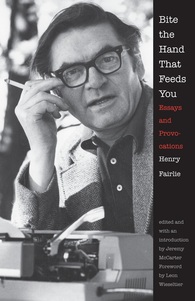
Bite the Hand That Feeds You


Amazon


Bn


Read excerpts


Contact


Praise for Bite the Hand That Feeds You:


A "Daily Endorsement" pick at Esquire.com:  "I read Bite the Hand That Feeds You. And I'm better and wiser for it. . . . It would have been nice to have had Henry Fairlie around during the Cheney presidency. It's a comfort to have the next best thing." — Tim Heffernan, Esquire


"An engrossing anthology" -- Timothy Noah, "Henry Fairlie, Health Maven," Slate


"Happy is the occasion when a publisher sees fit to gather and gift-wrap a bouquet as fragrant and resplendent as Henry Fairlie's political journalism.  A Grub Street transplant, Fairlie brought to America a fluency in history and prose, a jagged wit, a newcomer's affection for the New World, and a set of self-destructive life-style habits charming only in hindsight. We could use more of his kind. . . . This smartly edited collection gets him at his best. . . . Fairlie's take-down of George Will is a real joy."  — The New Yorker


"[Fairlie's writing] all remains fresh and reading through it is like attending a circus." — James Boylan, CJR  


"If you don't know the work of Henry Fairlie, you should check out a wonderful new collection of his writing, Bite the Hand That Feeds You, edited by Jeremy McCarter. His introduction is really superb — told me much I did not know and more I'd forgotten about a great bohemian Tory — and the pieces crackle with life and humor and passion. Perhaps they weren't truly journalism, for they live on, alongside Henry's fearless, love-driven spirit." — Andrew Sullivan


"If you doubt that political essays can induce something like ecstasy, I have three names for you. George Orwell, of course. Dwight Macdonald. And Henry Fairlie — who, with this book, may finally get his due."   — Hendrik Hertzberg, senior editor, The New Yorker 


Recommended by The Daily Beast: "one of journalism's great iconoclasts."


A "Summer Books" selection of the National Post of Canada


"Written in (almost) unfailingly superb English, [Fairlie's essays] retain their appeal mostly because they display a sort of romantic Toryism and yet contain a celebration of American individualism. . . . The word 'raffish' might have been coined for him." — Christopher Hitchens, The New York Times Sunday Book Review


A "Summer Book Pick" in The Village Voice: "In 32 timely and relentlessly witty essays, ranging from the political ('A Cheer for American Imperialism') to the whimsical ('The Importance of Bathtubs'), Fairlie proves why he was widely considered to be one of the best multidisciplinary journalists of the last 50 years."  


"McCarter offers Fairlie in full, as far as is probably possible."    — Sean Wilentz, Princeton University, author of The Age of Reagan: A History, 1974-2008


______________________


He coined the term "the Establishment," lit up Fleet Street and Washington, and picked fights with media giants— especially the ones who employed him. This summer, one of the 20th century's most original and incisive voices returns in Bite the Hand That Feeds You: Essays and Provocations by Henry Fairlie.

The British-born journalist, author, and social critic spent four decades skewering pieties on both sides of the Atlantic in the pages of The New Republic, The New Yorker, The Washington Post, The Spectator, and elsewhere. When he died in 1990, he was hailed as "quite simply the best political journalist, writing in English, in the last fifty years.”

Remarkably prescient and timely, Fairlie’s essays celebrate Winston Churchill, old-fashioned bathtubs, and American empire; they ridicule Republicans who call themselves conservatives and yuppies who want to live forever; and they skewer cynical pundits and wannabe media stars.

With an introduction by Jeremy McCarter and a foreword by Leon Wieseltier, the book shows how Fairlie's chaotic life became the stuff of legend, and why — at a time when America's confidence is shaken and its political traditions are being remade — he still has so much to tell us.


"What Fairlie brought to journalism, in England and in America, was his intelligent vehemence, the generous gift of his subjectivity. He did not 'do' voice, he had one, the only one of its kind."  
— from the foreword by Leon Wieseltier


Bite the Hand That Feeds You: Essays and Provocations
By Henry Fairlie; edited and with an introduction by Jeremy McCarter

Published by Yale University Press/New Republic Books in June 2009.

Available at Amazon, B&N, and independent bookstores everywhere.

For publicity/media inquiries, contact alden.ferro@yale.edu.


A Henry Fairlie Sampler

On the free press: "Of course my criticism of Kennan was ad hominem; if it had not been it would have been ad nauseam. Politics and politicians live by words—free government is wordy government—and we had better be in there pitching our words ad hominem against theirs."

On America: "I had been in the country about eight years, and was living in Houston, when a Texas friend asked me one evening: 'Why do you like living in America?' . . . After only a moment’s reflection, I replied, 'It’s the first time I’ve felt free.'"

On contaminated Perrier: "No scotch has ever been found to be contaminated. The God of Presbyterians, and He is a jealous God, would not countenance it."

On media cynicism: "The moral information which has been lacking in the coverage of this year’s election is the conviction that the political world is inherently good. It is as if every journalist is afraid that he might be caught in believing in something or in somebody."


About Henry Fairlie

Henry Fairlie was one of the most colorful and trenchant journalists of the twentieth century. Born in London in 1924 to a hard-drinking journalist father and a minister's daughter, he read Modern History at Oxford and briefly contemplated a political career before starting work in papers and magazines. He became chief leader writer on domestic politics at The Times at an extraordinarily early age, but decided to give up a salary and its attendant security to live the life of a freelancer -- which he remained for the next 36 years. At the Spectator, while writing under the nom de plume "Trimmer", he was credited with helping to shape the modern political column -- and coined the term "the Establishment."  On Fleet Street, he sparred in print with the likes of Kenneth Tynan and caroused with Kingsley Amis, among many others.

On Fairlie's first visit to America in the 1960s, he fell in love with the place, and moved here for good. Though famous as a conservative in England, he directed most (though by no means all) of his abuse at Republicans, feuding with William F. Buckley, George Will, and the neocons.  With his book The Kennedy Promise, he became one of the first JFK revisionists, only to write more warmly of the late president when he saw what Reaganism was doing to the country.

A man of legendary charm, Fairlie nevertheless had a chaotic personal life, and managed to wear out many of his welcomes. By the mid-1980s, he was unable to pay his rent, and was cast out of his Washington apartment. He would spend his last five years living in his office at The New Republic. Unbowed, he went on writing beautiful essays about about letters, Scotch, "greedy geezers", and why he loved America. When he died in 1990, his colleagues remembered him as "one of the last tribunes of a tougher, richer, grander time."


About Jeremy McCarter

Jeremy McCarter has written for Newsweek, New York Magazine, The New York Times, and  The New York Sun, and edited at The New Republic. He studied history at Harvard and lives in New York.

You can email him here.


Photo of Henry Fairlie by Marianne Pernold Young, pernoldphoto.com.